
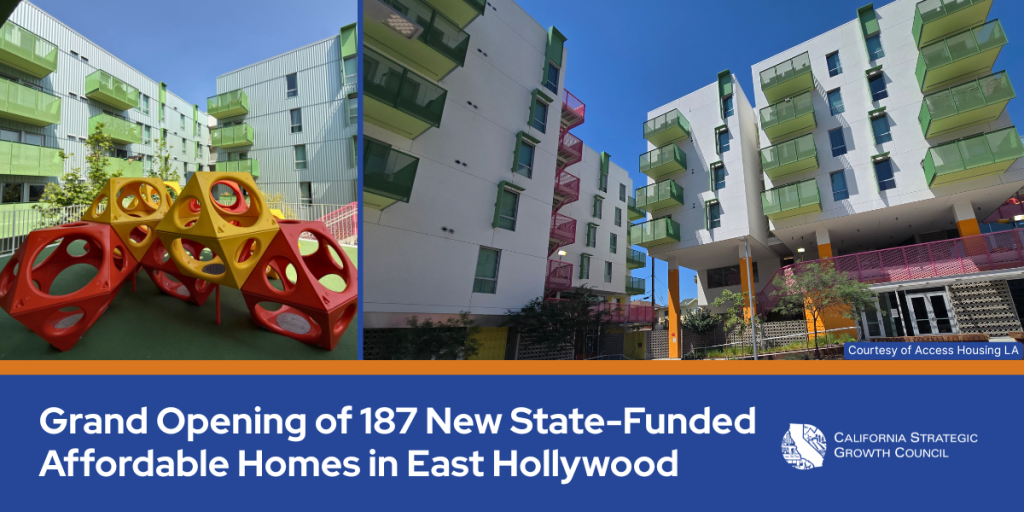
$51.2 million state investment helped bring project to fruition
Media Contact: LCI.press@lci.ca.gov
LOS ANGELES (5/1/26) — Community leaders joined state and local officials to celebrate the grand opening of the Santa Monica and Vermont Apartments in East Hollywood, a development of 187 new affordable, supportive homes in walking distance of businesses and public transportation hubs.
The apartments, built in part with more than $51.2 million in state investment, provide much-needed affordable housing for low- and extremely low-income families.
“California is continuing to show how smart housing and land use practices can advance our state’s climate goals,” said Governor Gavin Newsom. “By investing in affordable housing and connected communities, we’re reducing pollution, expanding opportunity, and helping more Californians have a place to call home.”
READ: Governor’s Office press release
In an area with relatively low median household incomes, these homes offer a critical resource for the community.
Half of the units are dedicated to formerly unhoused people, and the complex has on-site wraparound social services to help buoy residents as they rebuild their lives.
The six-story project, built adjacent to the Metro Public Plaza Station, was developed by the nonprofit social service organization, Little Tokyo Service Center Community Development Corp., in collaboration with local and state government agencies and private corporations, including the Los Angeles County Metropolitan Transportation Authority (Metro).
The project includes 20,000 square feet of commercial and social space prioritizing local businesses, including a pharmacy, a health clinic, a convenience store, and a food court.
“These apartments not only represent vital housing options in East Hollywood, but they are another example of the benefits of linking affordable housing, community-oriented retail, and public transportation,” said Erin Curtis, executive director of the SGC, which provided nearly $30 million through its Affordable Housing and Sustainable Communities (AHSC) Program to support the project. “These are the types of multi-benefit projects the Strategic Growth Council loves to support: The development of affordable, sustainable communities with greener, public transportation options and community-focused amenities right at residents’ doorsteps.”
The housing development, celebrated April 30, also brought with it a full suite of transit improvements in the area, adding key route connections and new and improved local and express bus stops and shelters.
With California positioned as a global leader in tackling climate change and the housing crisis, the apartments stand as a reflection of the environmental and comprehensive land use goals of the administration of Governor Gavin Newsom.
“This project is bringing a much-needed infusion of affordable housing to East Hollywood, with the services to help residents maintain housing stability and explore opportunity readily available through connection to transit,” said HCD Director Gustavo Velasquez. “We are proud to work with the Strategic Growth Council to create sustainable communities that help Californians thrive.”
The apartment complex is part of a Metro plan to build 10,000 housing units near transit hubs by 2031. It was created and developed with deep coordination with the community it serves, reflecting the needs of the neighborhood and solutions tailored to the residents.
Placing housing near public transit is a critical strategy to reduce housing shortfalls and lower housing costs while supporting the state’s climate goals. The strategy allows residents to use public transportation and walk to shops and services, providing them independence and access, while saving money on vehicles and gas.
California Climate Investments
The AHSC Program is funded through California Climate Investments, a statewide program that uses billions of Cap-and-Invest dollars to fund projects that reduce harmful emissions, protect public health, strengthen local economies, and support natural environments. With a strong focus on communities most impacted by pollution and limited access to resources, California Climate Investments helps build a more equitable and sustainable future.
California Climate Investments includes 117 programs administered by 27 state agencies, with funding directly supporting the Governor’s work to build a California for All, meeting the housing needs throughout the state while also protecting California’s climate.
A Housing Approach That Works
From the very first moments of the Newsom administration, the national crisis of housing and homelessness – which was decades in the making – has been addressed with ingenuity, seriousness, and expertise. No other state has devoted as much time and attention to these twin problems. Governor Newsom is reversing decades of inaction by creating a foundational model, which has led to a 9% reduction in unsheltered homelessness, a first in more than 15 years:
✅ Creating shelter and support — Providing funding and programs for local governments, coupled with strong accountability measures to ensure that each local government is doing its share to build housing, and create shelter and support, so that people living in encampments have a safe place to go. This week, through a $77 million investment from California’s cap and invest program, Los Angeles announced the expansion and redevelopment of the largest public housing project in the region, the Jordan Downs Project.
✅ Addressing mental health and its impact on homelessness — Ending a long-standing 7,000 behavioral health bed shortfall in California by rapidly expanding community treatment centers and permanent supportive housing units. In 2024, voters approved Governor Newsom’s Proposition 1 which is transforming California’s behavioral health systems. When fully awarded, funding from Proposition 1 bonds is estimated to create 6,800 residential treatment beds and 26,700 outpatient treatment slots for behavioral health care.
✅ Creating new pathways for those who need the most help — Updating conservatorship laws for the first time in 50 years to include people who are unable to provide for their personal safety or necessary medical care, in addition to food, clothing, or shelter, due to either severe substance use disorder or serious mental health illness. Creating a new CARE court system that creates court-administered plans for up to 24 months for people struggling with schizophrenia and other psychotic disorders, often with substance use challenges.
✅ Streamlining and prioritizing building of new housing — Governor Newsom made creating more housing a state priority for the first time in history. He has signed into law groundbreaking reforms to break down systemic barriers that have stood in the way of building the housing Californians need, including broad CEQA reforms.
✅ Removing dangerous encampments — Governor Newsom has set a strong expectation for all local governments to address encampments in their communities and help connect people with support. In 2024, Governor Newsom filed an amicus brief with the Supreme Court defending communities’ authority to clear encampments. After the Supreme Court affirmed local authority, Governor Newsom issued an executive order directing state entities and urging local governments to clear encampments and connect people with support, using a state-tested model that helps ensure encampments are addressed humanely and people are given adequate notice and support.
About the California Strategic Growth Council
The California Strategic Growth Council is composed of 10 distinguished members including state-agency secretaries and directors, and three appointed members of the public. The Director of the Governor’s Office of Land Use and Climate Innovation acts as its chair.
The Council coordinates and works collaboratively with public agencies, communities, and stakeholders to achieve sustainability, equity, economic prosperity, and quality of life for all Californians.
About the California Department of Housing and Community Development
HCD helps to provide stable, safe homes affordable to veterans, seniors, young families, farmworkers, tribes, people with disabilities, and individuals and families experiencing homelessness so that every California resident can live, work, and play in healthy communities of opportunity.