
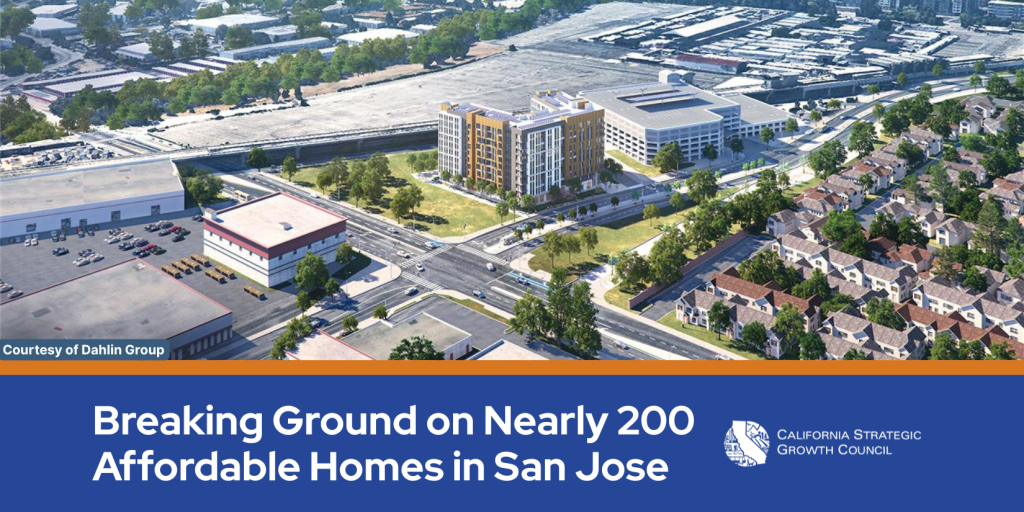
SAN JOSE (6/5/26) – State leaders joined community members and partners today to celebrate the groundbreaking of nearly 200 affordable homes at the Berryessa Transit Center in the City of San Jose.
The RISE project, funded in part by $38.5 million from the state’s Affordable Housing and Sustainable Communities (AHSC) Program, is the first phase of the Valley Transportation Authority (VTA) Berryessa/North San Jose Transit Center Transit-Oriented Development (TOD).
We’re thrilled to join our partners and the community to witness the groundbreaking of the 195-unit Berryessa development. This project demonstrates exactly what the California Strategic Growth Council and our partners are working to achieve throughout California—thriving neighborhoods with walkable, affordable communities near public transit.
“Today’s groundbreaking of the Berryessa Transit-Oriented Development reflects California’s commitment to expanding affordable, transit‑connected housing,” said Secretary Tomiquia Moss of the Business, Consumer Services and Housing Agency. “With 195 new affordable homes steps from BART, this project strengthens opportunity for families while advancing our climate and community goals.”
“This project will be a tremendous resource for the San Jose community, providing housing stability to residents at the lowest income levels and connecting them to job centers and opportunity through transit,” said HCD Director Gustavo Velasquez. “It is wonderful to see so many large units included, uplifting countless families over the life of this development.”
About the Development
The Berryessa TOD, which is being developed by Affirmed Housing, will be a new 10-story building with 195 units of 100% affordable housing for low-income, very low-income and extremely low-income families. More than 100 units will offer two or three bedrooms.
The complex will have direct access to the Berryessa transit station area and will be designed for Green Point Rated Gold or higher with a net-zero goal.
Project plans include indoor/outdoor community space, property management offices, case management offices and on-site resident services and resources, a computer lab, laundry facilities, children’s play facilities, and bike storage/repair facilities.
Transportation upgrades funded by the state’s AHSC Program include converting King Road into a safer, calmer street to better serve the needs of transit riders, bicyclists and pedestrians; five lane-miles of bus-only lane; two lane-miles of bikeways; and approximately 29,000 feet of safe and accessible walkway.
California Climate Investments
The AHSC Program is funded through California Climate Investments, a statewide program that uses billions of Cap-and-Invest dollars to fund projects that reduce harmful emissions, protect public health, strengthen local economies, and support natural environments. With a strong focus on communities most impacted by pollution and limited access to resources, California Climate Investments helps build a more equitable and sustainable future.
California Climate Investments includes 117 programs administered by 27 state agencies, with funding directly supporting the Governor’s work to build a California for All, meeting the housing needs throughout the state while also protecting California’s climate.
A Housing Approach That Works
From the very first moments of the Newsom administration, the national crisis of housing and homelessness – which was decades in the making – has been addressed with ingenuity, seriousness, and expertise. No other state has devoted as much time and attention to these twin problems. Governor Newsom is reversing decades of inaction by creating a foundational model, which has led to a 9% reduction in unsheltered homelessness, a first in more than 15 years:
Creating shelter and support — Providing funding and programs for local governments, coupled with strong accountability measures to ensure that each local government is doing its share to build housing, and create shelter and support, so that people living in encampments have a safe place to go.
Addressing mental health and its impact on homelessness — Ending a long-standing 7,000 behavioral health bed shortfall in California by rapidly expanding community treatment centers and permanent supportive housing units. In 2024, voters approved Governor Newsom’s Proposition 1 which is transforming California’s behavioral health systems. When fully awarded, funding from Proposition 1 bonds is estimated to create 6,800 residential treatment beds and 26,700 outpatient treatment slots for behavioral health care.
Creating new pathways for those who need the most help — Updating conservatorship laws for the first time in 50 years to include people who are unable to provide for their personal safety or necessary medical care, in addition to food, clothing, or shelter, due to either severe substance use disorder or serious mental health illness. Creating a new CARE court system that creates court-administered plans for up to 24 months for people struggling with schizophrenia and other psychotic disorders, often with substance use challenges.
Streamlining and prioritizing building of new housing — Governor Newsom made creating more housing a state priority for the first time in history. He has signed into law groundbreaking reforms to break down systemic barriers that have stood in the way of building the housing Californians need, including broad CEQA reforms.
Removing dangerous encampments — Governor Newsom has set a strong expectation for all local governments to address encampments in their communities and help connect people with support. In 2024, Governor Newsom filed an amicus brief with the Supreme Court defending communities’ authority to clear encampments. After the Supreme Court affirmed local authority, Governor Newsom issued an executive order directing state entities and urging local governments to clear encampments and connect people with support, using a state-tested model that helps ensure encampments are addressed humanely and people are given adequate notice and support.
About Affordable Housing & Sustainable Communities (AHSC)
AHSC is administered by the California Strategic Growth Council and implemented by the California Department of Housing and Community Development. AHSC is part of California Climate Investments, a statewide program that uses billions of Cap-and-Invest dollars to fund projects that reduce harmful emissions, protect public health, strengthen local economies, and support natural environments. With a strong focus on communities most impacted by pollution and limited access to resources, California Climate Investments helps build a more equitable and sustainable future.
About the California Strategic Growth Council
The 10 distinguished members of the SGC include state-agency heads and three appointed public members. The Director of the Governor’s Office of Land Use and Climate Innovation acts as its chair.
The council works collaboratively with public agencies, communities, and stakeholders to achieve sustainability, equity, economic prosperity, and quality of life for all Californians. SGC’s collaborative structure helps state agencies prioritize and uplift community voices into decision-making around the types of projects and resources that receive state climate resilience funds.
About the California Department of Housing and Community Development
HCD helps to provide stable, safe homes affordable to veterans, seniors, young families, farmworkers, tribes, people with disabilities, and individuals and families experiencing homelessness so that every California resident can live, work, and play in healthy communities of opportunity.