In communities across the state, the California Strategic Growth Council’s Transformative Climate Communities Program is empowering neighborhoods to build a more equitable and resilient future.
As California faces intensifying heat waves, droughts, flooding and wildfires, many already pollution-burdened, underserved communities are on the front lines.
To support neighborhoods amid these complex challenges, the State of California’s Transformative Climate Communities (TCC) grant program has been taking a bold, novel approach since 2018: Using grant funding to empower the communities most impacted by pollution to choose their own goals, strategies and projects to reduce greenhouse gas emissions and local air pollution and build resilience.
Administered by the California Strategic Growth Council (SGC) in partnership with the California Department of Conservation (DOC), the program has awarded more than $424 million to 37 communities across California since 2018. TCC funds three grant types: Planning Grants, Project Development Grants and Implementation Grants, which support activities from capacity building to pre-development to implementation.
With the funding, residents, local governments, and community-based organizations across the state are empowered to develop a shared vision for their neighborhoods and implement specialized solutions that create lasting change.
The Transformative Climate Communities Program was built on a bold vision: Empowering the people best equipped to understand and address local climate challenges – community members themselves – to plan and lead the work. Today, TCC is a model for community-driven investments that make communities healthier, more equitable, and more resilient.
From senior housing to accessible gardens, the results extend well beyond greenhouse gas reductions. These investments strengthen local economies, improve public health, increase access to affordable housing and transportation, expand green spaces, and reduce pollution in neighborhoods where state investment and local partnerships are needed most.
The success of TCC is measured not just in projects completed, but by lives improved. Californians breathe cleaner air and have access to safer neighborhood streets, healthier food, new job opportunities, and much more thanks to projects that community members prioritized. TCC has become a national model for the types of community-driven investments that make California healthier, more equitable, and more resilient.
Coachella Prospera
In Coachella, where the community has for many years faced affordable housing shortages, high rental costs and rising temperatures, TCC investments support the Coachella Prospera initiative, which aims to create a resilient and equitable community through engaged neighborhood planning, promoting healthy communities, and enabling older adults to age in place.
This includes access to recreational resources, zero-emission transportation, affordable housing, urban forests, and solar programs, along with infrastructure like sidewalks and bicycle trails that promote activity and mobility.
Recently, Coachella broke ground on Casa Sienna — the city’s first affordable housing community for low-income seniors. More than a place to live, the development connects residents to transit, medical services, parks, and supportive resources, allowing older adults to age with dignity while strengthening community health and resilience.
The Transformative Climate Communities Program can empower communities in so many ways. The Casa Sienna development is a boon both for the local environment and for the city of Coachella’s senior population. It is an honor to work with the California Strategic Growth Council to administer this program and to empower communities across the state to build toward a greener and more collaborative future.
The 52-unit development, which broke ground May 14, 2026, serves as a vital safeguard against displacement for fixed-income seniors, delivering premium comfort, comprehensive accessibility, and robust supportive services that empower residents to age with dignity.
Projects like Casa Sienna help ensure that our seniors can continue to live safely, independently and with dignity in the community they helped build.
On-site amenities include a 1,290-square-foot community building featuring a kitchen, restrooms, computer room, plus a property management office and 4,700 square feet of commercial space. Residents will have access to supportive services provided by the Pacific Southwest Community Development Corporation.
Richmond Rising
Led by a coalition of local organizations, Richmond Rising – with the help of TCC funding – is implementing projects envisioned by the community that will bring environmental, health, and economic benefits to the Iron Triangle, Santa Fe and Coronado neighborhoods.
Projects associated with Richmond Rising range from constructing new bike lanes to installing residential solar power systems, and from planting trees to furthering workforce development and job training programs.
Our Richmond Rising collaborative work is about so much more than funding projects; it’s about empowering our community to lead the way in building a sustainable and equitable future. Together, we are bringing to life the visions of residents, organizations, and the City of Richmond, all united in our commitment to address community health, equity, and sustainability in Richmond.
In June 2026, along a sunny, windy stretch of the Richmond Greenway, community leaders and residents gathered to celebrate a first for Richmond: the groundbreaking of a Universally Accessible Garden.
This is more than a garden for everyone — it’s a seed planted for a stronger, healthier, and more connected community.
A weedy, neglected site once full of debris from illegal dumping is being transformed into a vibrant community garden where residents of all abilities can participate in every stage of the growing process, from seed to harvest. The VistAbility program has regularly held cleanups at the site, having cleaned up an incredible tens of thousands of pounds of trash over the years.
The garden plans reflect the power of community vision and local leadership supported by state investment, with its accessible restrooms and outdoor seating, drinking fountains for people and service dogs, and compost areas.
The garden is the culmination of work led by the City of Richmond and Urban Tilth, a community-based organization dedicated to cultivating connections between residents and the land by advancing sustainable food systems while supporting the local economy through workforce development.
Arleide Santos, interim director of park equity and community programs for Urban Tilth, said June’s groundbreaking ceremony was an outward symbol of community coming together with a shared vision of inclusion, equity and belonging.
The Universally Accessible Garden will be a space where everyone, regardless of age or ability, can participate, learn, grow food, and reconnect with the land. It reflects our belief that access to nature, healthy food, and community should belong to all of us. Today marks the beginning of a space that will nurture plants, relationships, wellness, and a stronger sense of belonging for our entire community.
Transform Fresno
Funded by TCC, Transform Fresno is a historic process to identify and implement investments which will catalyze economic and environmental transformation in Downtown, Chinatown and Southwest Fresno.
The SGC truly listened to the concerns of the residents by writing policy guidelines that addressed the history of racial inequities and environmental injustice that has plagued Southwest Fresno. I believe that the transformation of Southwest Fresno will be a success and will improve the lives of current residents.
Projects ranging from street improvements to affordable housing to urban greening to solar and weatherization aim to address poverty, suburban sprawl challenges, and build resilience and opportunity.
One such project is the Saint Rest + Food to Share Hub in South Fresno, which was recognized as a model for revitalization of contaminated or underused properties.
The project transformed a previously vacant 6,800-square-foot warehouse into a community gathering place that provides healthy food distribution, nutrition education, cooking classes, and workforce opportunities.
Saint Rest Baptist Church and Fresno Metro Ministry led efforts to convert the contaminated, structurally unsound site into the Saint Rest + Food to Share Hub.
What was once an empty building now is a hub for feeding hundreds of families each month while creating local jobs and expanding access to healthy food.
In the heart of West Fresno, where access to fresh, healthy food is scarce and the daily reality of our community is marked by economic struggle, the Saint Rest Baptist Church Food Distribution Center stands as a beacon of hope. We are strategically positioned in the middle of a federally recognized food desert—a place where grocery stores are few, options are limited, and the disenfranchised suffer daily under the weight of systemic neglect. In this ‘mist of emptiness,’ our center is more than a building—it is a lifeline. State-of-the-art in design and function, our facility is equipped to store, preserve, and distribute food efficiently and with dignity. Every time our doors open, we serve approximately 400 local families, ensuring that children go to bed nourished, seniors have meals without choosing between medicine and groceries, and working parents have one less burden to carry. But beyond the physical provision, our food center represents a deeper truth: that our community is worthy of investment, care and resources equal to any other neighborhood. In a place where systemic disenfranchisement has sought to strip away hope, we have planted a hub of generosity and justice.
South LA Eco-Lab
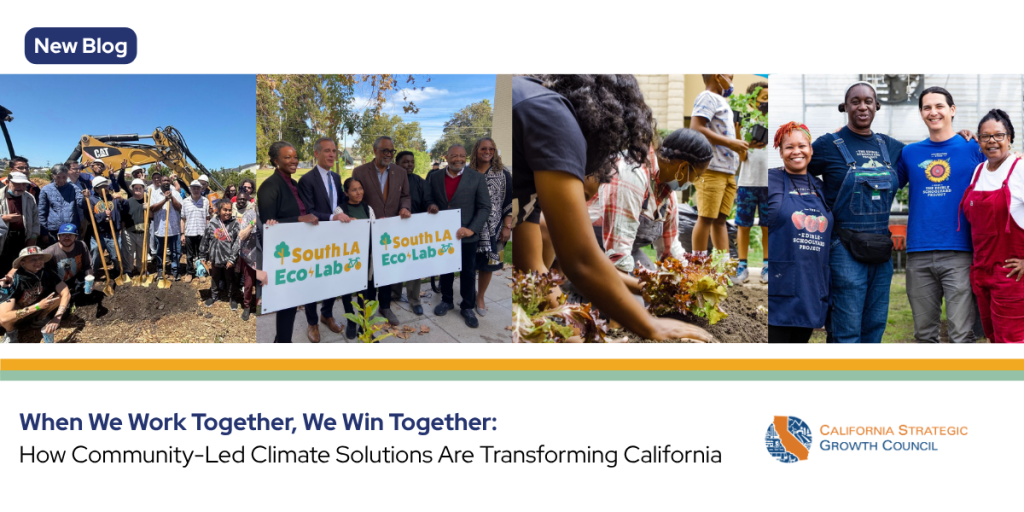
In South Los Angeles, with the help of a TCC grant, the South LA Eco-Lab initiative is creating a greener, healthier and more resilient neighborhood via economic development through climate action.
With a dozen interconnected projects, the South LA Eco-Lab brings together residents, small businesses, community-based organizations, and public agencies to address long-standing environmental and economic challenges in South Los Angeles.
The South LA Eco-Lab builds off the work from the South LA Climate Commons, funded under the Round 2 Transformative Climate Communities Planning Grant.
Projects address active transportation and public transportation access, solar installation and energy efficiency, urban greening, workforce development, resilience, and displacement avoidance.
New development and community can coexist, and that comes at the forefront of SAJE (Strategic Actions for a Just Economy) empowering the community.
Through the South LA Eco-Lab initiative, nearly 40 city blocks are getting cool pavement technology installed that reflects sunlight and lowers pavement temperatures.
Combined with other neighborhood improvements, these cooler streets will encourage walking, improve connections to schools and parks, and make everyday life safer and more comfortable during increasingly frequent heat waves.
The impact of redlining is evident in South Los Angeles. We experience high amounts of air pollution, heavy policing, lack of green spaces, and polluting industries, with some neighbors living five feet away from active oil wells. With support through the Transformative Climate Communities program, we want to reimagine a South LA that has clean air, more parks, free transit, and healthier community spaces that provide relief from extreme heat.
Community Led, Community Centered
Although each community’s priorities differ, the outcome is the same: implementation of locally led initiatives that create healthier neighborhoods, stronger local economies, and greater opportunities for residents.
These transformations begin with the people who know their communities best. Residents work alongside local government, community-based organizations and state partners to develop a shared vision for their neighborhoods and bring it to life through coordinated investments. The result is healthier food options, affordable housing, cleaner air, safer streets, and public spaces that prepare California’s neighborhoods for a more resilient future.
Rather than prescribing one solution, TCC is intentional about giving communities flexibility to pursue the strategies that best reflect local priorities.
In the words of the UCLA Luskin Center for Innovation, which tracks TCC progress and assesses outcomes: “The TCC Program is one of the most innovative, comprehensive, and equitable experiments in community-scale climate action.”
Learn about TCC Round 6, which is currently open for applications.
Learn more about each initiative through TCC’s Stories of Transformation.