
Media Contact: LCI.press@lci.ca.gov
SACRAMENTO (9/30/26) – The cities of Santa Cruz and Oakland celebrated vital additions to their affordable housing stock in the past few days – developments that include a total of 219 affordable homes close to public transit.
The two developments leverage nearby transit opportunities, with the goal of connecting residents with convenient, cost-effective public transportation for easy trips to work, schools, and shopping, while reducing traffic congestion and cutting tailpipe emissions.
“California is prioritizing providing people with safe, sustainable, and affordable homes, while also advancing our state’s climate goals,” said Samuel Assefa, Director of the California Governor’s Office of Land Use and Climate Innovation and Chair of the California Strategic Growth Council (SGC), which supported the project in partnership with the California Department of Housing and Community Development through the Affordable Housing and Sustainable Communities (AHSC) Program. The program has funded nearly 25,000 affordable homes since its inception. “These homes show what’s possible when we invest in affordable housing near transit, shops, and everyday services; families have more opportunities, neighborhoods grow stronger, and people can get around with less time and money.”
The projects were funded in part by more than $63.5 million from state grant programs, including AHSC and the Infill Infrastructure Grant Program.
“With these projects, California continues to advance its affordable housing and climate goals, and the result is hundreds of new homes which will help families in Oakland and Santa Cruz thrive, including those who are experiencing homelessness,” said Tomiquia Moss, Secretary of the California Housing and Homelessness Agency (CHHA), who is a member of SGC. “By focusing on affordable housing steps from transit and great amenities, California’s investments will make a genuine difference in people’s lives.”
With the high cost of living in the Bay Area and Central Coast regions, these new affordable homes are critical for local communities and the economy.
Santa Cruz Development
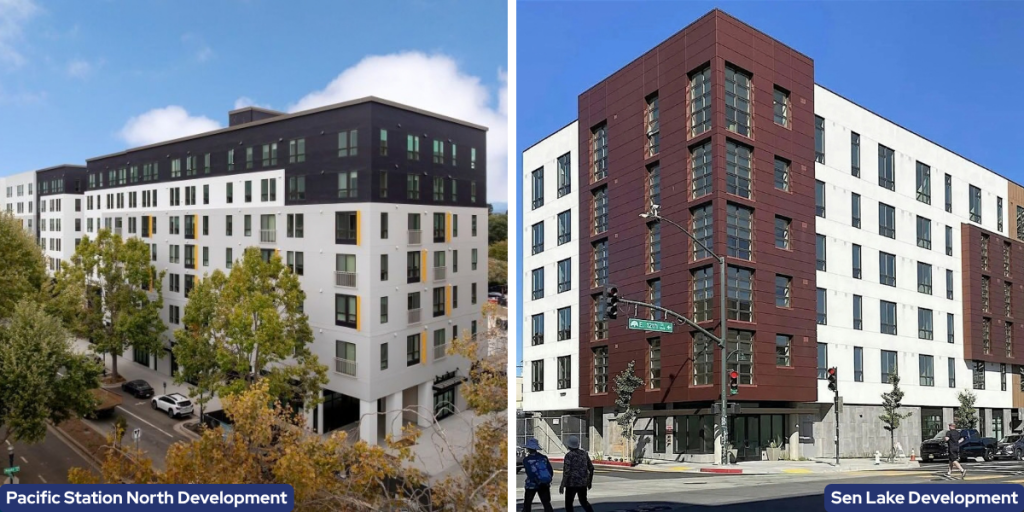
Yesterday, Sept. 29, Eden Housing marked the grand opening of Pacific Station North, a new 128-unit affordable housing and mixed-use project in Santa Cruz.
Developed in partnership with the City of Santa Cruz and For the Future Housing, the six-story high-rise project completes one of the final phases of Pacific Station, a large-scale, transit-oriented redevelopment program located between Pacific Avenue and Front Street in downtown Santa Cruz.
The project, designed to be all-electric, includes ground floor retail and commercial space, a new METRO bus transit hub, a pedestrian paseo, and key infrastructure to serve the whole redevelopment.
Thirty-two of the units will be set aside for extremely low-income households, with 21 units reserved for individuals and families who are homeless or at risk of homelessness and 11 project-based voucher units with a preference for households with Emergency Housing Vouchers. The remaining units will be restricted to individuals and families earning less than 50% and 60% of the Area Median Income for Santa Cruz County.
The residential common areas include a 1,300 square-foot outdoor patio, 1,250 square-foot community room, central laundry facility, computer room, and flex space for an after-school program. There will also be workforce development and youth technical training services.
AHSC transportation investments include a scenic trail, bike route, traffic improvements, signage, seating and lighting, along with one free transit pass for three years for each restricted unit.
Oakland Development
Last Friday, a ribbon-cutting ceremony for Sen Lake project in Oakland’s Eastlake neighborhood showcased 91 affordable housing units overlooking Lake Merritt and close to neighborhood shops, schools, community services, and public transportation.
Developed by the East Bay Asian Local Development Corp., Jordan Real Estate Investments and The Unity Council, about a quarter of the apartments are set aside for people who are currently experiencing homelessness or who were formerly homeless. Those apartments include access to free, voluntary supportive services, such as case management, to help residents maintain stable housing.
The project integrates low- and moderate-income affordable housing with community enhancements, including a 2,000-square-foot public cafe and sustainable transit infrastructure improvements.
The AHSC-funded transportation improvements include the installation of 50 pedestrian-scale LED lights, 3,000 linear feet of sidewalk, crossings, wayfinding, and bulb outs, as well as the installation of new bike channels at two entrances of the Lake Merrit BART station and a new 40-foot hybrid bus for AC Transit.
California Climate Investments
The AHSC Program is funded through California Climate Investments, a statewide program that uses billions of Cap-and-Invest dollars to fund projects that reduce harmful emissions, protect public health, strengthen local economies, and support natural environments. With a strong focus on communities most impacted by pollution and limited access to resources, California Climate Investments helps build a more equitable and sustainable future.
California Climate Investments includes 117 programs administered by 27 state agencies, with funding directly supporting the Governor’s work to build a California for All, meeting the housing needs throughout the state while also protecting California’s climate.
A Housing Approach That Works
From the very first moments of the Newsom administration, the national crisis of housing and homelessness — which was decades in the making — has been addressed with ingenuity, seriousness, and expertise. No other state has devoted as much time and attention to these twin problems — and California is a leader in producing positive results.
About the California Strategic Growth Council
The 10 distinguished members of the SGC include state-agency secretaries and directors, and three appointed members of the public. The Director of the Governor’s Office of Land Use and Climate Innovation acts as its chair.
The council works collaboratively with public agencies, communities, and stakeholders to achieve sustainability, equity, economic prosperity, and quality of life for all Californians. SGC’s collaborative structure helps state agencies prioritize and uplift community voices into decision-making around the types of projects and resources that receive state climate resilience funds.
About the California Department of Housing and Community Development
HCD, part of the new Housing and Homelessness Agency, helps to provide stable, safe homes affordable to veterans, seniors, young families, farmworkers, tribes, people with disabilities, and individuals and families experiencing homelessness so that every California resident can live, work, and play in healthy communities of opportunity.