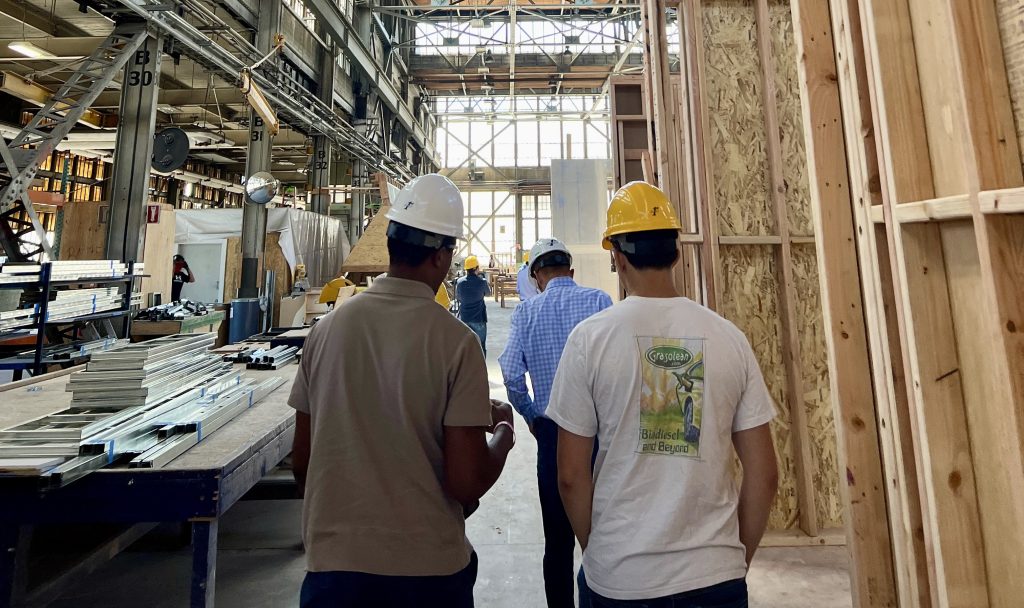
Grantees include a mix of large regional accelerators and more targeted regional initiatives spanning seven regions of the state
Media Contact: lci.press@lci.ca.gov
SACRAMENTO (08/31/2026) – The California Strategic Growth Council (SGC) has approved $10 million in grant funding to accelerate the development and use of factory-built housing across the state.
Investments from SGC’s Factory-Built Housing (FBH) Regional Pilot Program will fund 10 projects in seven regions: three in greater Los Angeles, two in the Bay Area, and one each in the Sacramento Valley, Sierra Nevada, Inland Desert, North Coast, and San Joaquin Valley. The grants awarded at the Aug. 26 council meeting support everything from wildfire recovery in Los Angeles to tribal use of climate-resilient hempcrete to workforce-housing development to mass-timber strategies.
“Factory-built housing is fast becoming an essential tool to build more affordable housing, faster, while supporting California’s job and climate goals,” said Samuel Assefa, Director of the California Governor’s Office of Land Use and Climate Innovation and Chair of SGC. “It also helps communities move from loss to stability faster after disasters and uses resilient materials to protect families into the future. We’re proud to invest in innovative, scalable housing solutions at such a critical moment.”
By investing in regional partnerships and flexible implementation strategies, the FBH Pilot Program empowers communities to scale housing solutions that align with local goals and statewide priorities.
“In order to end California’s housing crisis, we need innovative solutions, and investing in factory‑built housing is one of them,” said California Housing and Homelessness Secretary Tomiquia Moss, who is one of the 10 distinguished SGC members. “This pilot is helping us test and develop new models that deliver homes faster, more efficiently, and with greater climate resilience. By investing in local capacity and deepening regional partnerships, we’re advancing scalable affordable housing solutions grounded in the strengths of each community.”
Why Factory-Built Housing?
As California faces a growing need for housing that is affordable, equitable, climate-smart and resilient, the state is also working to meet ambitious greenhouse gas (GHG) reduction goals, confront the increasing frequency of climate-related disasters, and support long-term recovery in vulnerable communities. The FBH Pilot Program is designed to help meet these intersecting challenges by accelerating the adoption of factory-built housing solutions that are efficient, sustainable, and adaptable to diverse community needs.
Factory-built homes and components are built off-site in controlled, high-efficiency facilities and delivered ready for installation. These homes can be designed with durable, fire-resistant materials and climate-adaptive features. For communities facing extreme heat, smoke events, and worsening climate risks, these resilience features can protect households and entire neighborhoods. And, by allowing families to rebuild more quickly on their original lots or nearby, factory-built housing helps preserve the social connections that make communities strong — including access to jobs, schools, health care, and support networks.
Investments in factory-built housing also strengthen California’s workforce by supporting training pathways, skilled jobs in high‑efficiency construction, and new economic opportunities in regions that are building and deploying factory‑built housing.
In short, factory-built housing can:
- Get people into homes faster.
- Lower costs through streamlined, low-waste production.
- Improve resilience with durable, fire-resistant materials and climate-adaptive designs.
- Reduce emissions by relying on high-efficiency, environmentally responsible manufacturing.
- Create job opportunities.
- Support a wide range of housing types—from backyard ADUs to mid-scale infill projects—adaptable to the character and needs of different communities.
FBH Program-Funded Projects
Eaton Fire & Palisades Fire Modular Housing Recovery Initiative: Building a Regional Factory-Built Housing Deployment Framework for Altadena and Pacific Palisades Fire Recovery Communities
Integrity Custom Built will develop a factory-built housing wildfire recovery model for households affected by the Eaton and Palisades Fires. Through partnerships with Polaris Modular, Skyline/Champion Homes, and local community organizations, the project will produce pre-approved modular housing designs built for high‑wildfire‑risk areas, a regional permitting navigation guide, a homeowner education program, and demand aggregation strategies. This initiative aims to accelerate rebuild timelines and produce a replicable modular wildfire recovery model.
“Twenty years ago, I was building modular homes in New Orleans after Katrina — about 130 of them — and the hardest part was never the construction. It was that families didn’t know factory-built housing was an option, and the permitting system wasn’t built to say yes,” said Chris Bridgeford, Founder and CEO with Integrity Custom Built, Inc. “That is exactly where Altadena and Pacific Palisades sit today, nearly two years on, with more than 16,000 structures destroyed and most of those lots still empty. This grant funds the missing framework: pre-approved, fire-resilient plans cleared through HCD, LA County and City of LA, a permitting guide families and contractors can actually follow, training for local builders, community outreach delivered alongside the DENA Revitalization Network founded by Henry Dotson, and a toolkit that packages all of it — the plans, the permitting maps, the cost data — so any California builder or city can use it. Nothing in this grant builds a house. All of it clears the path so a family can.”
Innovating New Factory-Built Homes for the Redwood Region
Building Lives by Building Structure will advance tribal-led innovation in “hempcrete” panelized factory-built housing for the North Coast’s tribal and rural communities by exploring the potential economic, environmental, and resiliency co-benefits of hempcrete panels, which use hemp fiber, lime, and admixtures to replace conventional fiberglass insulation. Partnering with the Hoopa Valley Tribe, Backman Building Services, and GRID Alternatives, BLBS will design early-stage prototypes, assess feasibility, examine permitting pathways, and develop workforce strategies aligned with the Hoopa Modular Plant. The project will support resilient, low-carbon housing and strengthen tribal capacity to integrate factory-built solutions.
“We are incredibly honored and grateful to receive the Factory-Built Housing grant award. This transformative investment will help expand innovative, affordable housing solutions that benefit families across Northern California and beyond,” said Frank Richards, Board Chair and Lead Instructor for BLBS. “By combining locally sourced building materials, climate-resilient construction, consumer-focused home designs, and efficient permitting processes, our project will help remove barriers to homeownership while creating healthier, more sustainable communities. This grant is more than an investment in housing – it is an investment in people, partnerships, and the future. As some of the original homebuilders of California, we look forward to sharing our experience in the wider region. We are excited to build homes, strengthen communities, and create opportunities that will positively impact generations to come.”
Bay Area Middle Housing Accelerator
FBH Program funding enables partners across Alameda County to produce modular design prototypes, zoning reforms, and streamlined permitting tools that expand “missing middle” housing. This support is essential for scaling infill housing strategies that local jurisdictions cannot advance on their own.
“We are thrilled by this opportunity to advance housing production and environmental sustainability hand-in-hand,” said Timothy Burroughs, Executive Director of StopWaste. “By scaling up factory-built housing, our Bay Area collaborative aims to efficiently deliver the middle-income homes our communities need, while simultaneously keeping valuable resources out of landfills, lowering carbon emissions, and building a regional circular economy.”
“Every city in California is looking for ways to build housing faster and at a lower cost. This grant allows us to develop a new model that combines faster approvals, factory-built construction, and flexible financing to make it easier to build on smaller housing sites,” said Rebecca Foster, CEO at the Housing Accelerator Fund, which is collaborating with lead applicant StopWaste and municipal partners from the County of Alameda, the City and County of San Francisco, and the Bay Area Housing Finance Authority. “At scale, this approach could ultimately bring hundreds of affordable homes to Bay Area neighborhoods.”
Built Different: A Blueprint for Factory‑Built Housing in the Greater Sacramento Valley
The program’s investment accelerates development of standardized modular designs, risk‑reduction financing guidance, and streamlined permitting informed by six active modular projects. Funding is critical to delivering a replicable zero‑net‑energy affordable housing roadmap for the Sacramento Valley.
“This is an extraordinary investment in what a nonprofit affordable housing developer can do when given the opportunity to innovate at scale,” said Craig Adelman, CEO, Mutual Housing California. “We’re thrilled the California Strategic Growth Council is backing Mutual Housing’s vision for factory-built housing—not just as a more efficient way to build, but also to expand what’s possible for communities that need affordable housing. This grant allows Mutual Housing and our partners to prove the effectiveness of these ideas through six affordable factory-built housing communities, then share what we learn so other developers across California can benefit.”
Unlocking Factory-Built Missing Middle Housing
cityLAB-UCLA will design modular prototypes and regulatory strategies to enable small-scale multifamily “missing middle” housing statewide. Working with Abundant Housing LA and the modular firm Villa Homes, the project will conduct feasibility analysis, produce factory-built prototypes, and develop zoning and permitting tools to help cities reduce regulatory barriers.
DreamBuild Riverside County
DreamBuild will align land use, permitting, infrastructure readiness, and workforce development to support early-stage regional capacity for factory-built housing in the Eastern Coachella Valley. The project will improve modular literacy, support rural infill opportunities, and build groundwork for future modular development in a high-need region.
Factory‑Built Workforce Housing Program (partial award)
FBH Program funding will allow Anaheim to create modular prototypes, employer‑assisted finance models, and permitting strategies that address the region’s jobs‑housing mismatch. This support is vital for expanding workforce housing options in high‑cost communities.
The FORGE Initiative: Factory-Built Housing Opportunity, Regional Governance, and Equity in the San Joaquin Valley
The FORGE Initiative will build a regional foundation for factory-built housing capacity across Stanislaus, Merced, and San Joaquin counties. The project will produce factory-built housing ecosystem analyses, workforce alignment tools, permitting guidance, and a site-readiness pipeline. FORGE will strengthen regional coordination and prepare the Valley for future factory-built housing production.
“This support from the Strategic Growth Council will catalyze some collective impact strategies in our community by investing critical capital into regional coordination efforts,” said Stanislaus Equity Partners. “This will then accelerate our ability to deliver sustainable, accessible housing opportunities to individuals and families across our region. We are grateful for this partnership and excited for the long-term impact it will bring to our community.”
California Factory‑Built Housing Accelerator: Mass Timber (partial award)
FBH Program funding is key to developing statewide mass timber permitting tools, cost‑reduction strategies, and standardized modular designs that resolve inconsistent local processes. The program’s support strengthens a predictable, scalable mass timber supply chain for multifamily housing.
Tahoe Truckee Regional Mass Timber Factory‑Built Housing Initiative (partial award)
FBH Program support enables creation of modular mass timber prototypes tailored to high‑wildfire‑risk mountain communities, along with Wildland Urban Interface‑aligned permitting guidance and coordinated regional planning tools. Funding is essential for piloting a forest‑to‑housing model that rural jurisdictions cannot develop alone.
“We are deeply grateful to the California Strategic Growth Council for funding our project to scale mass timber capacity building across the Tahoe Truckee region,” said the Tahoe Prosperity Center team. “In addition to supporting regional housing needs, this work advances forest health, wildfire risk mitigation, and environmental sustainability through leveraging local wood resources for high-value building materials.”
Program Background
The FBH Pilot Program was created in 2023 to help California deal with major, overlapping challenges — like the need for affordable housing, preparing for climate impacts, cutting pollution, and rebuilding after disasters. Now in its third round, the program has been refined through community and industry feedback to help local partners accelerate factory-built housing so communities can build safer, more resilient homes faster. Awards were selected using a portfolio-based approach that balances geographic diversity, equity, and technical innovation to maximize statewide impact.
About the California Strategic Growth Council
The 10 distinguished members of the SGC include state-agency heads and three appointed public members. The Director of the Governor’s Office of Land Use and Climate Innovation acts as its chair.
The council works collaboratively with public agencies, communities, and stakeholders to achieve sustainability, equity, economic prosperity, and quality of life for all Californians. SGC’s collaborative structure helps state agencies prioritize and uplift community voices into decision-making around the types of projects and resources that receive state climate resilience funds.