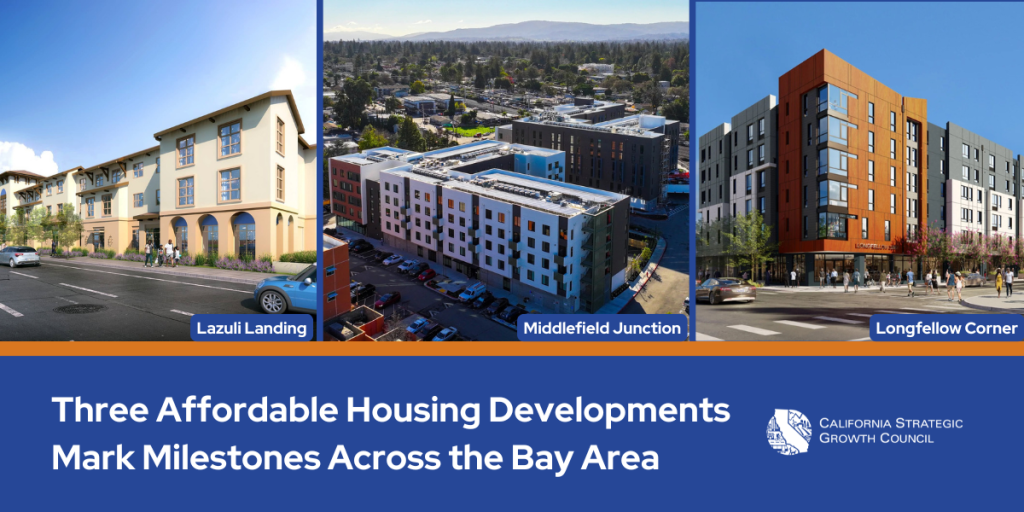
SACRAMENTO (5/15/26) — In just one week, three communities celebrated significant milestones as they build 377 affordable homes across the San Francisco Bay Area.
In Union City, Redwood City and Oakland, state-funded affordable housing projects are rising near public transportation, local schools and other daily destinations. State programs contributed a total of $161 million to the projects.
With the high cost of living in the Bay Area, these new affordable homes are critical for local communities and the economy.
“California is prioritizing the development of much-needed housing while keeping our climate goals front and center,” said Samuel Assefa, Director of the California Governor’s Office of Land Use and Climate Innovation and Chair of the California Strategic Growth Council (SGC), which provided funding through the Affordable Housing and Sustainable Communities (AHSC) Program. “By investing in affordable, sustainable communities near transit and other key amenities, we’re supporting health, thriving neighborhoods — and there are many more AHSC-funded projects in the works statewide.”
“California is moving with urgency to build more climate-smart affordable homes, and these developments show what’s possible when state and local partners stay focused on the people who need them most,” said Secretary Tomiquia Moss of the California Business, Consumer Services and Housing Agency. “These projects strengthen our communities, expand access to opportunity, and reflect the kind of practical, community‑driven solutions we’re advancing across the Bay Area and the state.”
Redwood City
On Thursday, May 14, the Middlefield Junction development celebrated a dedication ceremony, marking the grand opening of 179 apartment homes. The development was funded in part by more than $25.4 million from the AHSC Program.
The mixed-use community provides affordable housing for families in Redwood City’s North Fair Oaks neighborhood, with all 179 apartments reserved for households earning between 15% and 80% of the area’s median income. Within the complex, 44 units are set aside for specific programs managed by Healthy Housing California and the San Mateo County Project-Based Voucher program.
The development includes a child-care center and several indoor and outdoor gathering spaces.
The state also invested in the purchase of electric SamTrans buses for the expansion of an express bus line; over 2 miles of new bikeways; just under 1.2 miles of new or replaced sidewalk; 68 crosswalks; curb extensions; train cars; “smart tech” amenities; bike storage on site; urban greening; accessible gates; and a shade structure.
Each restricted unit will also get one free transit pass for three years and career training will be provided to the community.
“It is exciting to see so many Bay Area affordable housing projects opening their doors or moving toward completion thanks to our partnership with the Strategic Growth Council to create energy-efficient communities near transit and opportunity,” said HCD Director Gustavo Velasquez. “In addition to our shared work on the AHSC, HCD’s No Place Like Home, Multifamily Finance Super NOFA, and Accelerator programs have all played a critical role in bringing these much-needed developments to life.”
Union City
With the first story of the Lazuli Landing affordable housing development now becoming visible, partners marked the milestone with a wall raising ceremony on May 8.
Lazuli Landing, funded by $21.1 million from the state’s AHSC Program, will include 81 units restricted to households earning a range between 20%-80% Area Median Income (AMI).
The project will provide a mix of one-, two-, and three-bedroom apartment homes, including one manager’s unit. Planned amenities include a multi-purpose community room with kitchen, a second-level outdoor play area, secure bike storage, and on-site parking. The development will also feature a ground-floor commercial space leased to the City of Union City’s Youth & Family Services (YFS), providing additional community-serving resources including career training.
The funding also invests in two new BART rail cars, a new bikeway, and pedestrian improvements consisting of compliant pedestrian curb ramps and crosswalk improvements. Each restricted unit also receives one free transit pass for three years for each restricted unit and career training for the community.
“These three state-supported Bay Area developments will not only offer hundreds of much-needed affordable housing units — they will enhance quality of life for everyone in those neighborhoods with easy transportation options and on-site, community-focused amenities,” said Erin Curtis, Executive Director of the California Strategic Growth Council, noting that AHSC has funded nearly 25,000 affordable homes since its inception. “We’re proud to support these community-centered projects and the strong partnerships that bring the region together to strengthen resilience — and this is just a drop in the bucket for upcoming AHSC projects in the Bay Area.”
Oakland
On Thursday, May 14, Longfellow Corner marked a milestone with a hardhat tour.
The project, funded in part by more than $19.5 million from AHSC, is in its final phase of construction.
The development, only a few blocks from the MacArthur BART station, will include 77 affordable homes, and 34 apartments will be dedicated to permanent supportive housing. The property also includes 14 units that are accessible and/or have features for those with auditory and visual impairments.
The property will include a community room with a common kitchen, secure bike storage, common laundry, a landscaped courtyard, free internet service, and a smoke-free and pet-friendly community. There will also be 2,500 square feet of community-serving commercial space on the ground floor.
State funding is also geared toward BART rail cars; upgraded lighting; bikeways; pedestrian improvements; curb ramps; accessible parking; sidewalk extensions; signal heads; high visibility crosswalks; tree planting; bicycle education workshops; reduced-price transit pass for three years for each restricted unit; and workforce development.
California Climate Investments
The AHSC Program is funded through California Climate Investments, a statewide program that uses billions of Cap-and-Invest dollars to fund projects that reduce harmful emissions, protect public health, strengthen local economies, and support natural environments. With a strong focus on communities most impacted by pollution and limited access to resources, California Climate Investments helps build a more equitable and sustainable future.
California Climate Investments includes 117 programs administered by 27 state agencies, with funding directly supporting the Governor’s work to build a California for All, meeting the housing needs throughout the state while also protecting California’s climate.
A Housing Approach That Works
From the very first moments of the Newsom administration, the national crisis of housing and homelessness — which was decades in the making — has been addressed with ingenuity, seriousness, and expertise. No other state has devoted as much time and attention to these twin problems — and California is a leader in producing positive results.
About Affordable Housing & Sustainable Communities (AHSC)
AHSC is administered by the California Strategic Growth Council and implemented by the California Department of Housing and Community Development. AHSC is part of California Climate Investments, a statewide program that uses billions of Cap-and-Invest dollars to fund projects that reduce harmful emissions, protect public health, strengthen local economies, and support natural environments. With a strong focus on communities most impacted by pollution and limited access to resources, California Climate Investments helps build a more equitable and sustainable future.
About the California Strategic Growth Council
The 10 distinguished members of the SGC include state-agency secretaries and directors, and three appointed members of the public. The Director of the Governor’s Office of Land Use and Climate Innovation acts as its chair.
The council works collaboratively with public agencies, communities, and stakeholders to achieve sustainability, equity, economic prosperity, and quality of life for all Californians. SGC’s collaborative structure helps state agencies prioritize and uplift community voices into decision-making around the types of projects and resources that receive state climate resilience funds.
About the California Department of Housing and Community Development
HCD helps to provide stable, safe homes affordable to veterans, seniors, young families, farmworkers, tribes, people with disabilities, and individuals and families experiencing homelessness so that every California resident can live, work, and play in healthy communities of opportunity.