HiAP Grant and Contract Evaluation Tool Step 2: Navigating the Application Process
Navigating the application process is a key step to any grant or contract. Public agencies can take a variety of steps to ensure applications are clear, accessible, and set applicants up for success.
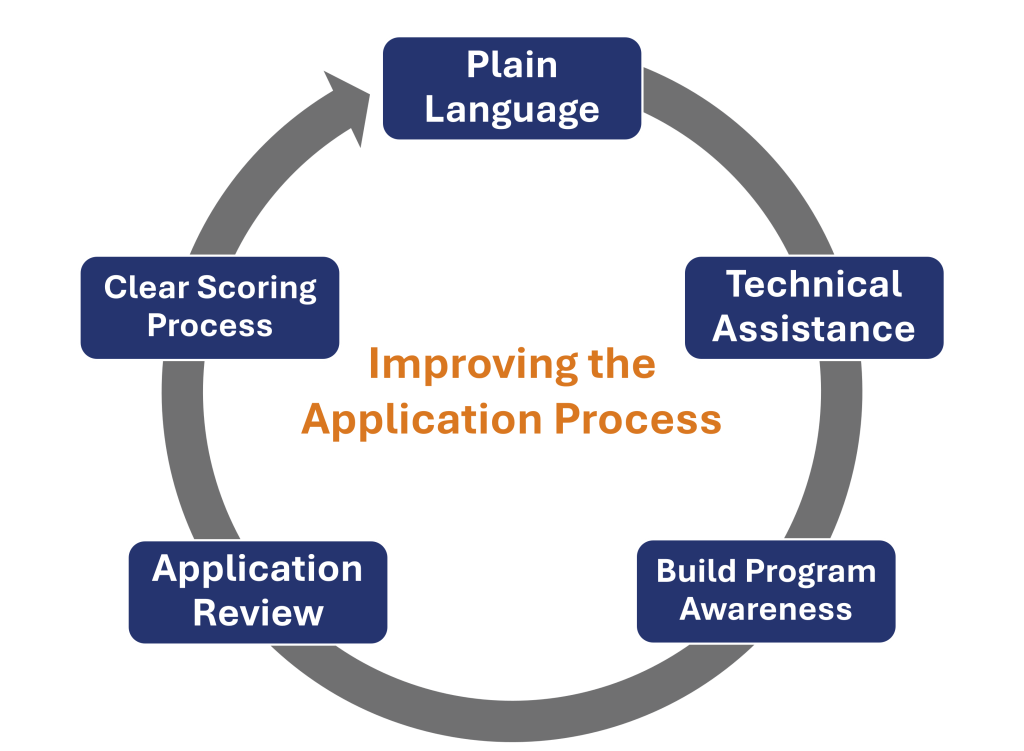
A. Ensure Grants and Contracts Include Accessible and Plain Language
The Plain Writing Act of 2010 defines plain writing as “clear, concise, well-organized, and consistent with other best practices appropriate to the subject or field and intended audience. [Plain] writing avoids jargon, redundancy, ambiguity, and obscurity.”
These principles can be applied all communications, known as Plain Language. As the California Office of Data and Innovation defines, “plain language ensures equal access to information.”
Plain writing and language are effective approaches to ensure information about grants and contracts are accessible to all. Grant and contract information can be detailed and technical. For more information on developing grant templates and guidelines, visit the Strategic Growth Council TA Toolkit Contracting Guidance webpage.
- Have you reviewed the Culturally and Linguistically Appropriate Services (CLAS) standards and/or have examples of accessible language published by your agency? Do you have input from your communities on specific language access requests?
- Have you reviewed the California Office of Data and Innovation Plain Language Checklist?
B. Plain Language in Application Design
Provide a summary of the work at the beginning of the application.
- Can you summarize the following components for applications in simple language?
- 1) Information about the agency’s effort;
- 2) Program goals;
- 3) Eligible applicants
Use plain writing and language to ensure the application is easy to understand and available in accessible formats. The application template should include a budget amount, clear timelines, and outline of associated deliverables.
- Does language comply with Section 508 of the Americans with Disabilities Act (ADA)? Is all language user-friendly and translatable, if appropriate? Can you offer webinars in different languages if requested?
- Have you reviewed the California Office of Data and Innovation Plain Language Checklist?
Application design should be grounded in objectives to ensure that deliverables are clear for grantees and contractors.
Ensure the application is developed with knowledge of what it actually takes to do the work, and in what sequence.
- For contracts, does this meet basic Department of General Services (DGS) requirements?
- Have you reviewed compensation policies? Does potential compensation meet the standard of living in different geographic areas?
- If needed, can you get outside support and/or reviewers who are knowledgeable about compensation policies? (Generally grant program officers are familiar with these policies, however, people administering contracts may not be.)
Ask grantees and contractors to submit proposal with a (flexible) workplan and budget. Workplan may include the budget for ease of access and tracking by administrating program and grantee alike.
- Are the work plan and budget aligned? (This supports ease of reporting later on).
C. Application Technical Assistance Support
Program administrators can support applicants in various ways, including supporting grantors and contractors with information that will support their application. Educational webinars and public meetings can help support applicants, including with multiple learning formats. Grants or Contracts teams hold at least two public webinars to provide an overview of application criteria, with ample time for Q&A. Your office may offer “Office Hours” for grantees to ask specific questions as they arise.
- Keep the seminars as a simple, step-by-step process. Is translation available for the seminars? Are staff available to answer questions in other languages? Are the presentation slides shareable?
- Have you submitted questions and official answers openly to ensure fairness and transparency?
- Is there a large enough window for the agency to answer questions via email that allows grantees or bidders to implement the changes needed for the submission?
- Have you provided examples of budgets, narratives, and reporting templates that are easy to understand and replicate?
- Do you have people available to provide potential grantees with support in the following areas?
- Project scoping
- Application writing
- Budgets
- Narrative question reviews
D. Evaluation Rubrics
Evaluation criteria take into consideration barriers that priority populations might have, including Tribes. Agencies that post grants or contracts can increase applicant access to the program by publishing scoring rubrics that internal staff use to score applications. Your agency may have existing scoring rubrics or may be able to reference existing rubrics such as:
- California Development Block Grant Scoring Matrix (California Department of Housing & Community Development)
- Active Transportation Program Plan Scoring Rubric (California Department of Transportation)
- For grants or contracts with Tribes, have you reviewed the SGC Tribal Technical Assistance Guidance?
Collaborative governance is a model that can ensure work across sectors, partners, and communities. Implementing this model can help ensure design, review, and evaluation of grants are community-centered. Including communities at this stage of grant implementation can build trust, community power, and equity. Collaborative evaluation models may ensure that information collected is sufficient – and not more than is truly needed. Collaborative practices can create stronger feedback loops between agencies and applicants.
To learn more about collaborative governance, visit the SGC Community-Driven Investment Model.
- Are Tribes included in the review, public comment, or feedback process for your grant?
- How can equity, trust, and self-determination be strengthened through the evaluation process?
E. Reporting Requirements (specific to Grants)
Ensure the qualitative and quantitative reporting measures are equitable in terms of time and administration, and relevant to the type and level of work to be done.
- Have you aligned reporting cycles with existing data collection (e.g., quarterly instead of monthly reporting, if appropriate).
- Can reporting requirements be set based on the amount awarded to grantees or contracts? For example, smaller, non-competitive awards could have more flexible reporting requirements. Reporting should not disproportionately consume the limited administrative time of smaller or under-resourced organizations. Regular informal check-ins with the grantee can ensure the work is being done.
F. Application Review Panel
Ensure the application review panel is clear on scoring measures and that reviewers have the content knowledge on the actual work required (e.g., if it is a community engagement grant or contract, ensure the panel has knowledge on effective community engagement strategies).
- Does the application review panel have subject matter expertise for the areas in which the grant is being administered?
- Do members of the application review panel represent the communities served?